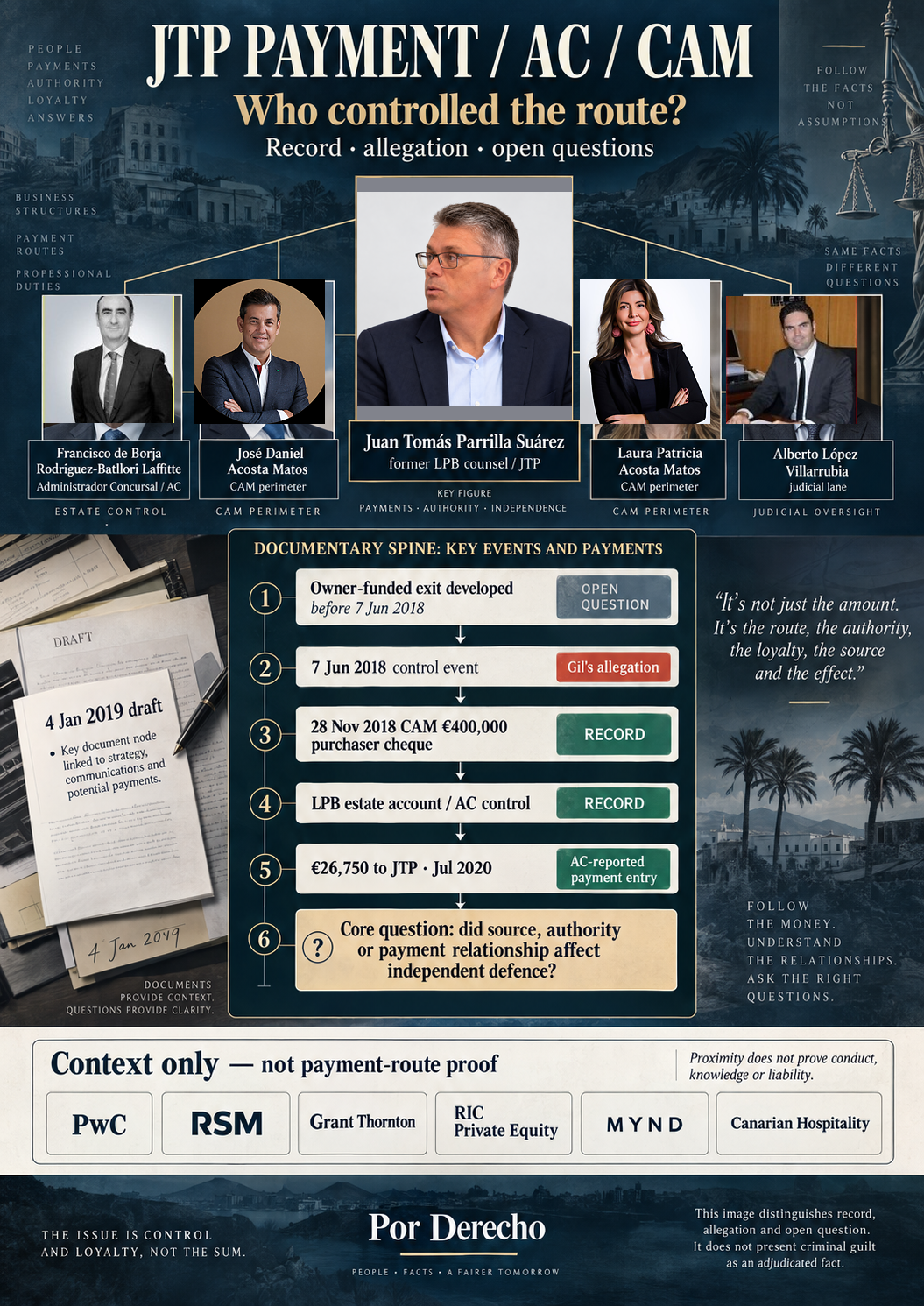
ONA/Clubotel, Stoneweg and Cuatrecasas records place a materially developed operating, DD, term-sheet and insolvency-exit architecture before 7 June 2018. Closing was not guaranteed.
00 / CRIMINAL-PROSECUTORIAL SPINE
Five questions before civil, mercantile or insolvency remedies.
The organising question is not whether a lawyer could ever be paid from estate funds. It is whether a sequence of actor-specific acts, omissions, control points, communications and economic relationships warrants criminal investigation for interference with an already-developed exit and the independence of LPB’s defence.
Contemporaneous messages record the asserted CAM/Community possession event and immediate complaints, photographs/videos and requests for judicial protection. Authority, actors and criminal intent remain separate questions.
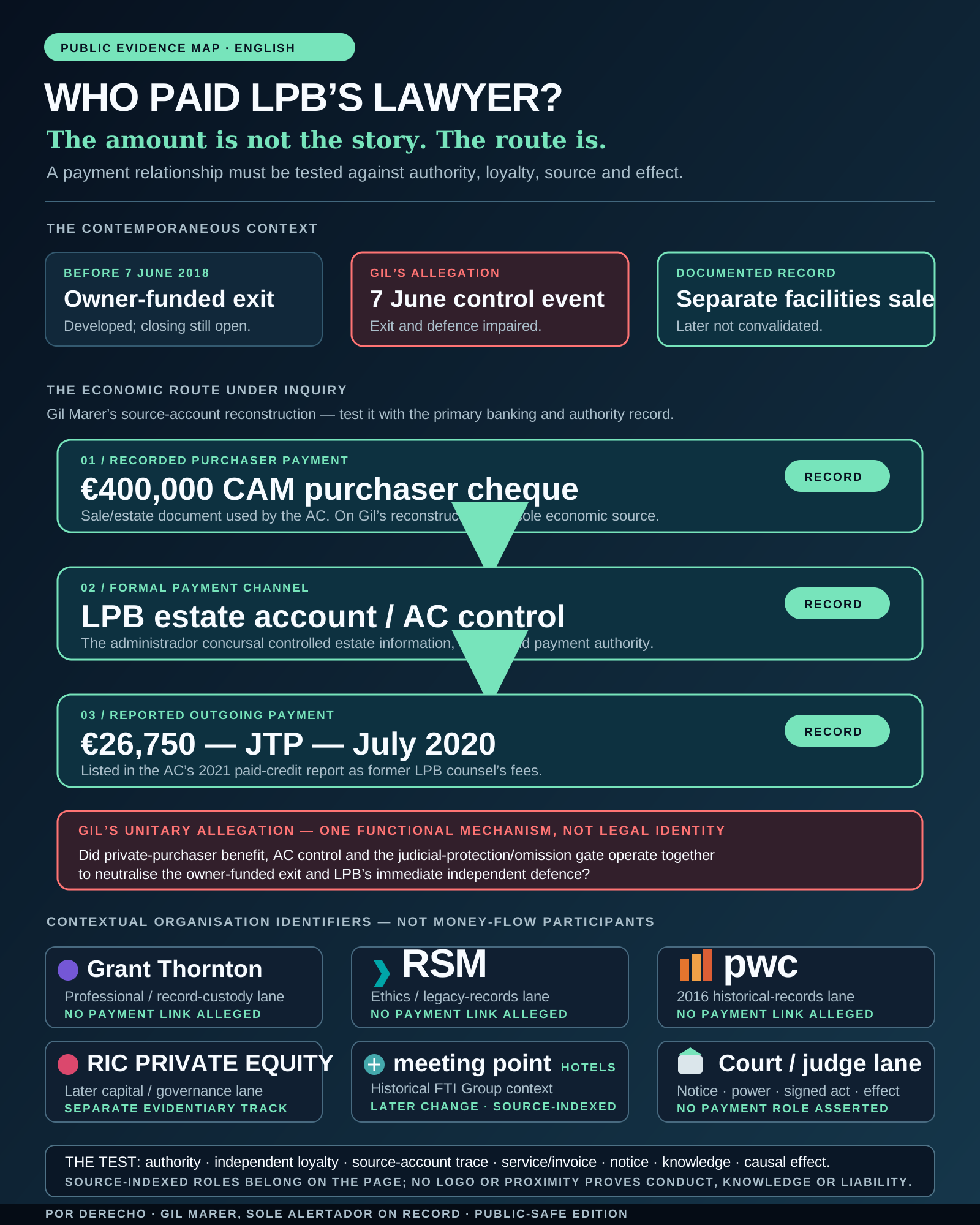
The later €400,000 CAM transaction, the LPB estate account and the AC’s payment/reporting role create a source-and-control question. The 2019 nonconvalidation and later legal developments remain part of the contrary record.
May–June 2020 records show AC/JTP fee discussions, intermediation and a “peace” sequence. By 1 June incoming counsel was already treating Parrilla as no longer LPB counsel and disputing his asserted fee entitlement/double-payment position. The client side expressly rejected Parrilla’s final proposal on 12 June; a later AC report records €26,750 paid.
Prosecutorial proof requires source, authority, communications, knowledge, any condition or reciprocal act, causal effect on defence/exit, and resulting benefit or harm. The page does not substitute chronology for those elements.
Criminal first means element first, not offence-label first. Civil, mercantile and insolvency law remain essential because they determine title, authority, estate treatment, duties and remedies. Here they operate as evidential predicates, counterevidence and remedy context. The first reading order is actor → act/omission → knowledge → purpose → causal effect → benefit/harm → legal characterisation.
Contemporaneous criminal lens — 4 January 2019. Parrilla’s own broad draft did not frame the dispute as merely civil or insolvency-procedural. It asked for referral to the Ministerio Fiscal in relation to possible estafa procesal, alteration of the liquidation process and administración desleal, while challenging the separate disposition and alleged delivery of possession to CAM without title. The draft’s filing remains unproved; its contents and authorship context are direct documentary evidence.
START HERE
Who paid LPB’s lawyer?
COMPANION EVIDENCE · 1 JUNE 2020
Representation had ended. Invoice authority was withheld pending clarification.
Read this correspondence with the actors/payment image. It adds a dated authority-and-knowledge question to the criminal/prosecutorial chain, not an isolated billing dispute.
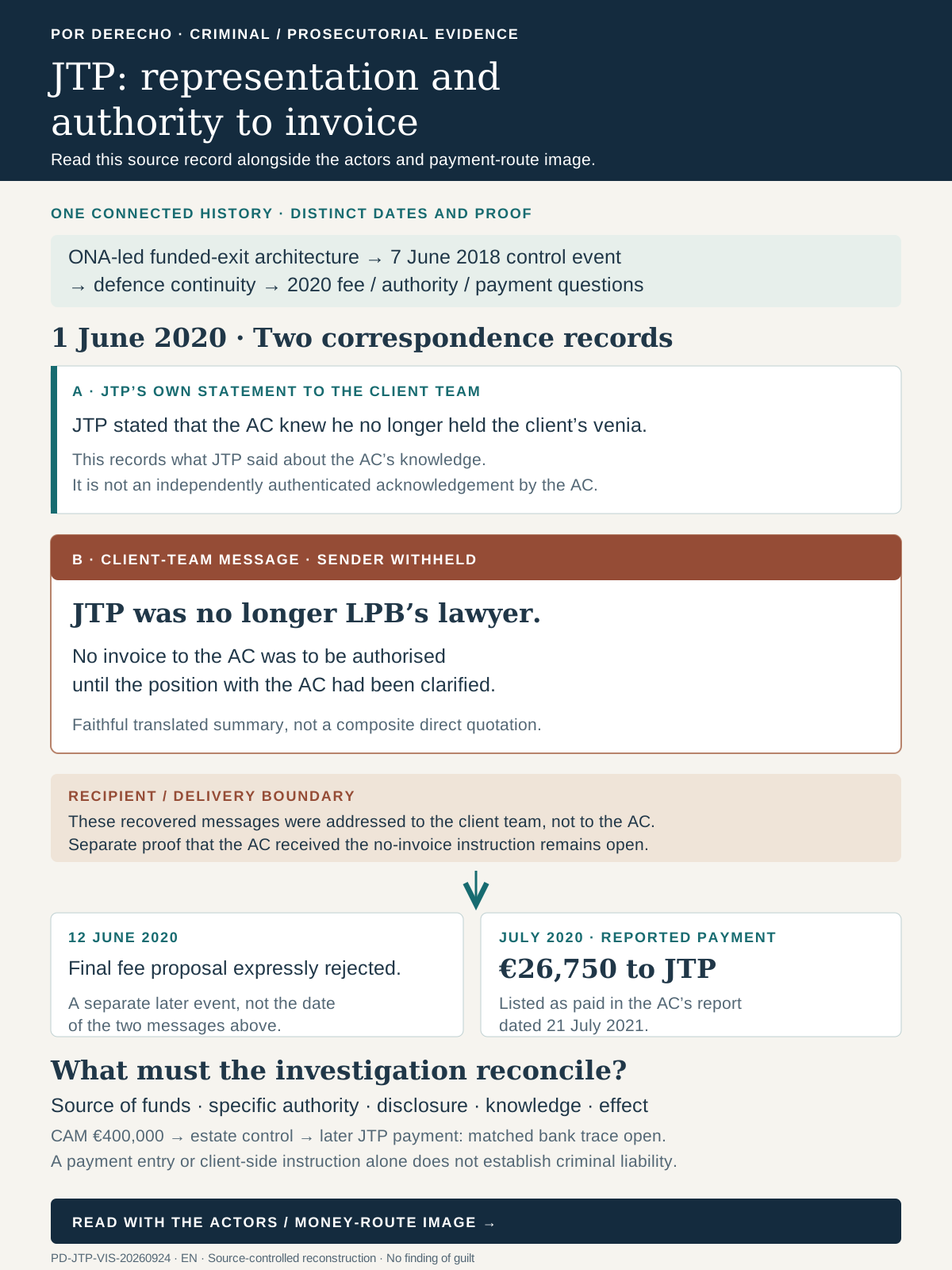
A · JTP’s statement
On 1 June 2020 JTP stated that the AC knew he no longer held the client’s venia. This is JTP’s statement about AC knowledge, not an independently authenticated acknowledgement by the AC.
B · Client-team message, sender withheld
A separate message that day said JTP was no longer LPB’s lawyer and no invoice to the AC was to be authorised until matters with the AC were clarified. The visual is a faithful summary, not a composite direct quotation.
Recipient and condition
These copies are addressed to the client team, not the AC. Delivery of the no-invoice instruction to the AC remains an open proof question. Ending representation and withholding invoice authority do not themselves extinguish any independently established accrued entitlement.
Read forward: the final proposal was rejected on 12 June 2020; the AC’s 21 July 2021 report separately lists €26,750 paid in July 2020.
Read backward: the ONA-led exit, the 7 June 2018 event and the defence history remain connected. Correspondence alone does not establish criminal intent or a completed bank trace.
Supersedes the unverified chat graphic’s 2018 fee-correspondence dates and its combined “communication to the AC” label. Existing actors-image bytes remain unchanged.
01 / SEQUENCE
Exit → sale → defence → fee
The ONA/Clubotel operating terms were signed on 6 June 2018. The owner side had developed buyer and finance routes, with closing steps still open. The administrator separately sold facilities to CAM on 28 November 2018 and reported a buyer cheque into an LPB account he controlled. LPB sought the deed through a filed request on 10 January 2019, and the court refused convalidation on 24 October. The administrator’s 21 July 2021 paid-credit report lists €26,750 for former LPB counsel Juan Tomás Parrilla as paid in July 2020.
Gil’s unitary allegation: a functional adverse mechanism, not legal identity. Gil alleges that, in the decisive 2018–2020 window, private-purchaser interest, the AC’s control of estate information, assets and payments, and the separate judicial protection/remedy gate operated together in practical effect to neutralise LPB’s independently instructed representation during the owner-funded exit and its immediate defence after 7 June 2018. Anti-fragmentation / domino rule: the fee episode is downstream, not the origin. The May 2018 correspondence records ONA bringing Stoneweg to Cuatrecasas to advance the transaction, discuss due diligence and term-sheet work, and coordinate the concurso route; the 7 June correspondence records immediate complaints and evidence preservation in response to CAM’s asserted possession; and the 12 June 2020 fee chain records an express rejection of Parrilla’s final proposal and a move toward an insolvency incident. The 2020 rejection directly proves rejection of that proposal. Gil’s further position—that it forms one downstream act of resistance to an alleged wider mechanism that had already impaired the ONA-led funded exit—is an attributed unitary inference, not a claim that the 12 June email by itself proves every upstream act or criminal element. This does not say that the actors became one legal person, that the judge was a payer or payee, or that association alone proves culpability. It is a joined causal case: each actor’s notice, duty, power, act or omission, knowledge and effect must be tested individually, and any coordinating mechanism must be proved with primary sources. Counsel’s protective work remains part of the record; the allegation concerns material windows and mechanisms of effect.
02 / NATIVE-SOURCE CLOSE · 24 SEP 2026
What the fee and authority records now establish — and still do not.
A fresh bounded review of the connected native email and Drive corpus strengthens the authority chronology while leaving the bank-source bridge open.
Parrilla’s 29-May-2012 pro-forma budget states €40,000 + IGIC: €20,000 + IGIC before filing and five later €4,000 + IGIC instalments. It is a budget, not a 2020 invoice.
Parrilla proposed a definitive €50,000 + IGIC fee, said €32,250 had already been received and described €17,750 + IGIC as remaining. He expressly said he required Gil/Patricia’s written approval before proceeding with either proposed AC-mediated route.
Jiménez forwarded the proposal saying it could not be accepted. Patricia agreed it was unacceptable, ended the discussions and directed the team toward the insolvency incident.
Jiménez then recorded that the team had broken the negotiations with Parrilla and the AC because, in his assessment, they were trying to condition the successor team’s work in exchange for fee payment. That is a contemporaneous professional assessment, not a judicial finding.
The AC’s 21-Jul-2021 report lists €26,750 paid in July 2020 to Parrilla for debtor-lawyer fees. €26,750 numerically equals €25,000 + 7% IGIC, corresponding numerically with an earlier immediate-payment figure; that does not establish which proposal, invoice or authority the payment implemented.
A 12-Jun→31-Jul-2020 search across the three connected mailboxes located no later written Gil/Patricia approval or superseding acceptance. Targeted Drive searches located no matching July-2020 bank debit/recipient credit. Those are bounded search results, not proof that no record exists elsewhere.
Reconciliation rule
Do not compare the gross €26,750 payment directly with the pre-IGIC €17,750 base balance as if they were like-for-like. The secure observations are: Parrilla stated €17,750 + IGIC remained; the AC later reported €26,750 paid; €26,750 equals €25,000 + 7% IGIC; and the 2020 final invoice/minuta, specific authority and matching bank trail remain unlocated. Open the source-close control →
03 / PROSECUTORIAL AND PROFESSIONAL INQUIRY
Why the payment relationship matters
The concern would remain if the amount were smaller or larger. Each question below requires its own evidence and legal assessment.
Gil characterises the exchange as part of repeated misuse of professional leverage and undue pressure. He states that Patricia, his partner and local representative in the Canary Islands, experienced the exchange as threatening and felt particularly vulnerable while handling the matter locally on his behalf, including the dimension he identifies of doing so as a woman, against the background of the representation failures, omissions, acts and refusals he attributes to Parrilla. Her 28 May reply is retained only as evidence for that alleged pressure and information asymmetry. It is not treated here as consent, waiver, ratification, negotiation, fee allocation or authority.
Contemporaneous advice described the insolvency-cost claim as belonging to client-side funders rather than automatically to the lawyer or procurador. Reconcile that position with the fee allocation, invoice, IGIC treatment, service and authority.
A lawyer’s instructions and judgment should serve LPB. Determine whether payment discussions with an actor adverse to LPB influenced the advice, litigation choices or silence.
The AC controlled estate payments while LPB and the AC had opposed positions in litigation. That structure calls for scrutiny of his legal basis, motives and safeguards.
A charge to the estate affects LPB and creditors. Identify the services, invoice, classification as a claim against the estate and approval or challenge route.
The prospect of payment can matter before cash changes hands. Fix each proposal and decision date and test whether counsel expected money controlled by the AC.
Compare payment discussions with each dated request, appeal, warning and missed opportunity concerning the ONA exit and hotel facilities; retain counsel’s protective work.
CAM bought the facilities; the AC reported receipt into LPB’s controlled account. Investigate any connection among buyer benefit, administrator decisions and counsel fee without assuming a direct CAM-to-lawyer payment.
Check whether privileged strategy, client instructions or settlement positions reached a party whose interests diverged from LPB’s; no breach is established by a payment entry.
Test what counsel disclosed about the payer, fee basis, communications with the administrator and any conflict affecting independent judgment. Patricia’s response is expressly excluded as proof of consent or validation; the relevant questions are counsel’s duties, conduct, disclosure and the objective payment record.
Identify how a specified act or omission changed a defined opportunity to protect the hotel as a unit, challenge the sale or pursue the developed exit; do not assume the exit was guaranteed.
Judicial protection and remedy are a distinct causal gate. Test exact notice, power, request, signed act or omission and effect. The judge’s own acts have a separate evidence lane; no record here shows that he ordered or received the fee.
If evidence shows dishonest diversion of estate funds, a bought change of loyalty, collusion or purposeful concealment, the elements and individual knowledge should be tested. A fee entry itself does not establish bribery or a crime.
Proof boundary
The 2018 buyer cheque and the reported July 2020 fee are distinct entries. The matched bank debit and credit, 2020 final invoice/minuta, specific payment authority, IGIC treatment, actual services, earlier incentive, each actor’s knowledge and causal effect remain to be verified. This reader does not use Patricia’s 28 May response to supply client authority, consent, waiver, ratification or validation. LPB could in principle lawfully pay its own lawyer from estate funds; the issue is whether this particular arrangement met the duties and benefited LPB.
04 / HOSTILE-READER TEST
The strongest adverse reading is shown, not hidden.
This is a simulated red-team, not a statement by any named adverse party. Each objection is the strongest good-faith defence the page should survive.
| Hostile proposition | What the record permits us to say | What remains open |
|---|---|---|
| “There is no CAM→JTP transfer.” | Correct. The page alleges no direct transfer. It asks whether CAM-origin value entered an AC-controlled estate channel later used for counsel payment. | Purchaser debit, LPB credit, complete ledger, matching €26,750 debit and recipient credit. |
| “LPB could lawfully pay its own lawyer.” | Correct in principle. The investigation concerns this arrangement’s source, authority, disclosure, independence, conditions and effect—not an abstract prohibition on paying counsel. | Invoice, engagement/fee basis, authority, IGIC, services and independent-benefit analysis. |
| “The client consented or later authorised payment.” | The 28 May reply is not used as consent or ratification. By 1 June incoming counsel was already treating Parrilla as no longer LPB counsel, disputing his entitlement/double-payment position and directing the fee issue into successor-counsel handling. On 11 June Parrilla himself said he required written Gil/Patricia approval before proceeding; on 12 June the client side expressly rejected the proposal. A bounded three-mailbox search through 31 July located no later written approval. | Any later authority, invoice or superseding agreement outside the bounded corpus remains producible and would materially narrow this point. |
| “The client replaced Parrilla, not the AC.” | Correct as the formal immediate transition. The page does not claim the AC formally dismissed Parrilla or exclusively caused the replacement. | Whether payment/intermediation materially influenced professional choices or the transition environment. |
| “Parrilla also performed protective work.” | Correct and preserved. The theory concerns defined windows, refusals/conflicts and payment/intermediation—not universal non-performance. | Act-by-act mandate, instruction, response and causal effect. |
| “2018 and 2020 are too far apart.” | Time alone proves nothing. Separate source sets establish the funded-exit, 7 June response, later estate liquidity and fee episode. The unitary causal bridge remains an allegation to test. | Knowledge and communication bridges showing whether actors connected the stages. |
| “The bank trace is incomplete.” | Correct. That is a P0 gap, displayed prominently rather than concealed. | Complete bank and estate-account reconciliation. |
| “ONA might never have closed.” | Correct. The page claims a materially developed exit, not guaranteed closing. | Closing conditions, financing certainty, required access/security and counterfactual probability. |
| “Later approvals cure the earlier story.” | Later lawful decisions are material contrary evidence but do not automatically answer earlier authority, knowledge, purpose or conduct. | Date-specific effect of each later order, deed, registry act and unwind/reconciliation step. |
05 / FALSIFICATION + PRODUCTION
What would narrow the thesis, and what a prosecutor should obtain.
Evidence that would narrow or falsify material parts
- A complete bank reconciliation showing the €26,750 came from unrelated, independently available lawful liquidity rather than the alleged source chain.
- A later written client approval or independently valid LPB authority approving the specific payment after full fee/source/conflict disclosure.
- Complete AC–JTP communications showing ordinary fee administration with no condition, “peace” linkage, information exchange or professional leverage.
- ONA/Stoneweg records showing the exit lacked material financing/closing viability before 7 June or that the 7 June event did not impair relevant closing assumptions.
- Actor-specific records showing the relevant person lacked knowledge of the exit or of the alleged downstream consequence.
Priority prosecutor production
- Purchaser debit, LPB account credit, complete Santander/estate statements, AC remuneration debits and the €26,750 debit/recipient credit.
- Parrilla invoice(s), IGIC, fee mandate, claim-recognition authority, services and estate ledger.
- Complete AC↔Parrilla and AC↔incoming-counsel communications, including the 1 June “peace” sequence and any CAM-related intermediation.
- ONA/Clubotel/Stoneweg DD, term sheet, financing, closing conditions, security assumptions and communications delivered to or known by the AC/court.
- 7 June access/keys/security instructions, Community act/minutes, complaints, images, witness records and person–act–time reconstruction.
24 September 2026 deep-source sweep:
Targeted searches across the connected Gmail accounts and Google Drive located the 4-Jan-2019 broad draft, the May–June 2020 fee/handover correspondence and the AC’s 21-Jul-2021 liquidation report recording the €26,750 July-2020 counsel payment. The same targeted sweep did not locate the underlying Parrilla invoice, executed payment authority, matched estate-account debit/recipient credit or a bank-complete €400,000→€26,750 trace. Absence from this targeted retrieval is not proof that the records do not exist; it is a dated open-proof result.
Hostile-reader acceptance rule:
If a contrary source closes a link, the unitary theory must narrow at that link. If a source strengthens a link, it may strengthen only that link and dependent propositions. Neither fragmentation nor evidential overreach is permitted.
06 / READ IN THE RIGHT ORDER
Criminal spine first; civil and insolvency predicates second.
Criminal / prosecutorial spine
ONA funded-exit architecture before 7 June →Additional ONA criminal-continuity analysis — GitHub edition →7 June 2018 material-control dossier →Defence-continuity and professional-pressure record →Unitary criminal hypothesis / institutional action →
Civil / mercantile / insolvency predicates and remedies
Procedural routes remain legally distinct. Cross-links show evidential dependency and chronology; they do not merge proceedings, parties, knowledge, intent or liability. The separately labelled GitHub edition is an external companion, not a claim of GitLab route parity.
07 / SOURCES
Source and legal controls
- AC liquidation report: buyer cheque, LPB account controlled by the administrator and his own paid fees.
- Filed 10 January 2019 deed request and 24 October 2019 court order: separate acts and a corrective ruling.
- AC paid-credit report dated 21 July 2021: lawyer listed as paid in July 2020, without a matched invoice or bank trail in this reader.
- Context index: Grant Thornton, RSM and PwC are shown only as distinct professional/record lanes; RIC Private Equity as a later capital/governance lane; Meeting Point/Hotels as a historical FTI-group operational context with a later source-indexed control change. None is shown as a payment-route participant.
- Adversarial method: hostile-reader / prosecutorial red-team control and machine-readable test matrix.
- Deep source sweep: 24-Sep-2026 source/negative-search audit and machine-readable source sweep.
- Fee-authority source close: native-source chronology and arithmetic correction and machine-readable control.
- Connected visuals: actors / payment ↔ 1 June 2020 authority record · provenance and correction control.
2001 Spanish Bar Statute, arts. 33 and 42 · 2019 Bar Code, arts. 2, 12 and 14 · Ley Concursal 22/2003 (applicable before September 2020)
Unfiled lawyer drafts and confidential correspondence are not published here.