GC-CIV-003 · DP 1041/2017 · CRIMINAL-FIRST · INVESTIGATIVE ALLEGATION

Did LPB lose its own procedural voice before its retracto route disappeared?

Gil Marer's public position. The sequence should be investigated first from a criminal-law perspective and then, without fragmenting it, through its civil, insolvency, administrative, patrimonial and restorative consequences. This page states an actor-specific, falsifiable hypothesis; it is not a judicial finding of guilt.

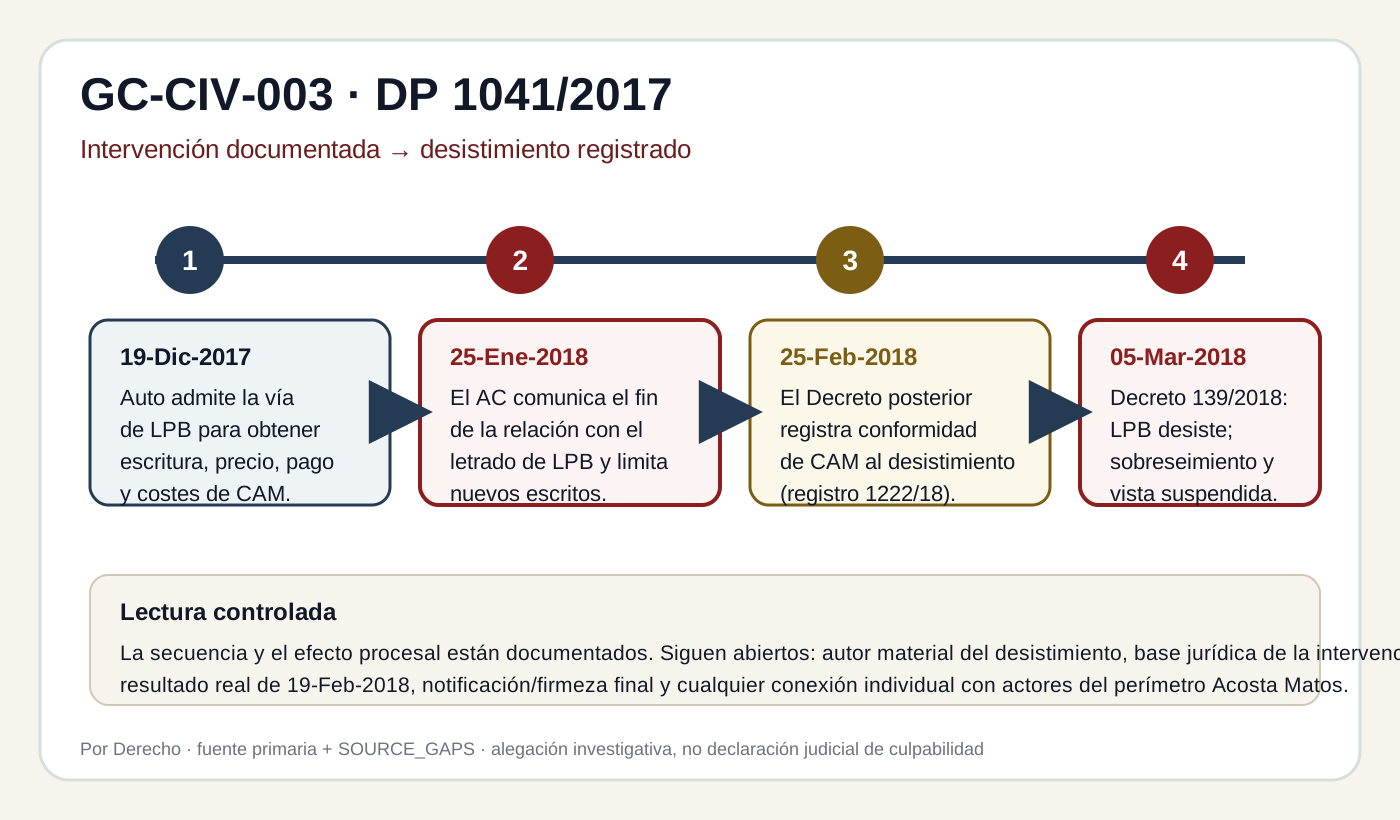
Source-controlled GC-CIV-003 sequence showing admission of LPB's diligence, documented insolvency-administrator intervention, CAM's recorded consent and LPB's recorded discontinuance.
Source-controlled scheme. The visual summarises the primary sequence while retaining the open SOURCE_GAPS. Click it to return to the proceeding record, NIG, court, judge, LAJ and source state.

The primary-source sequence

  1. 19-Dec-2017 · admission orderThe court admits LPB's preliminary-diligence request aimed at obtaining from Construcciones Acosta Matos, S.A. the 20-Oct-2017 credit-assignment deed, including concrete price, payment date and transaction costs.
  2. 18-Jan / 23-Jan-2018 · CAM requiredThe judicial source records a positive SCNE result and that CAM was cited/required on 18 January.
  3. 25-Jan-2018 · insolvency-administrator interventionA contemporaneous communication from Francisco de Borja Rodríguez-Batllori Laffitte, acting as insolvency administrator/liquidator, communicates termination of LPB's existing professional relationship with its lawyer and requests venia; it also instructs that the procurador file no further papers in these proceedings without his express consent.
  4. 25-Feb-2018 · CAM consentThe later Decree records that the opposing party did not oppose the discontinuance and consented through a filing dated 25-Feb-2018, registry 1222/18. The complete text of that filing remains to be recovered.
  5. 05-Mar-2018 · Decree 000139/2018The recovered primary judicial source records that LPB requested discontinuance, dismisses the matter under article 20.3 LEC, and suspends the then-pending hearing for 25-Apr-2018 at 11:15. The Decree was reviewable within five days; service and ultimate finality remain unproved.

What changes when the sequence is read criminal-first

Gil Marer alleges that the insolvency administrator's intervention should not be reduced to an ordinary litigation-management decision. He says it should be investigated as a possible standalone act of instrumentalisation: control over LPB's legal representation appears immediately before the discontinuance of a court process whose purpose was to compel CAM to disclose critical economic terms of the credit assignment.

The criminal question is not whether every change of lawyer or discontinuance is unlawful. It is what concrete authority the AC relied on, what instructions he gave, who drafted and filed the discontinuance, what LPB interest was being protected, what information ceased to be pursued, and who obtained the practical advantage from ending that judicial route.

The current evidence proves the sequence, the AC's intervention and the final procedural effect. It does not yet prove that Borja personally drafted the discontinuance, that the representation change was legally invalid, that there was an agreement with any identified Acosta Matos individual, or criminal intent, corruption or common purpose.

Standalone and, at the same time, part of a wider sequence

Gil says this episode warrants investigation as a standalone act and also as one part of a unitary reconstruction before, during and after the insolvency. In his hypothesis, the historic private-interest sequence — including the Molina/Montelanza perimeter as described by him and its later functional convergence with the Acosta Matos perimeter — should be tested against concrete acts by the insolvency administrator, procedural decisions, transfers of control, financing, adjudication, classification proceedings and later institutional responses.

This page does not elevate that continuity into a proven fact. It turns it into a testable question: was there a repeated transfer of capacity, information, position or value away from LPB and toward an adverse private perimeter, and which actor produced each transfer?

Private benefit: controlled formulation. In GC-CIV-003 the advantage presently identifiable is procedural and potential: the judicial mechanism designed to obtain from CAM the price, payment date and costs of the assignment came to an end. While the SOURCE_GAP remains open as to what actually happened on 19-Feb-2018 and whether equivalent disclosure occurred elsewhere, this page does not assert that CAM definitively avoided providing the information. Nor does it attribute individual participation in the discontinuance to Francisco Mario Matos Matas, Antonio Cogolludo Rojas, Shaila María Cogolludo Ramos, José Daniel Acosta Matos or Laura Patricia Acosta Matos without specific source evidence.
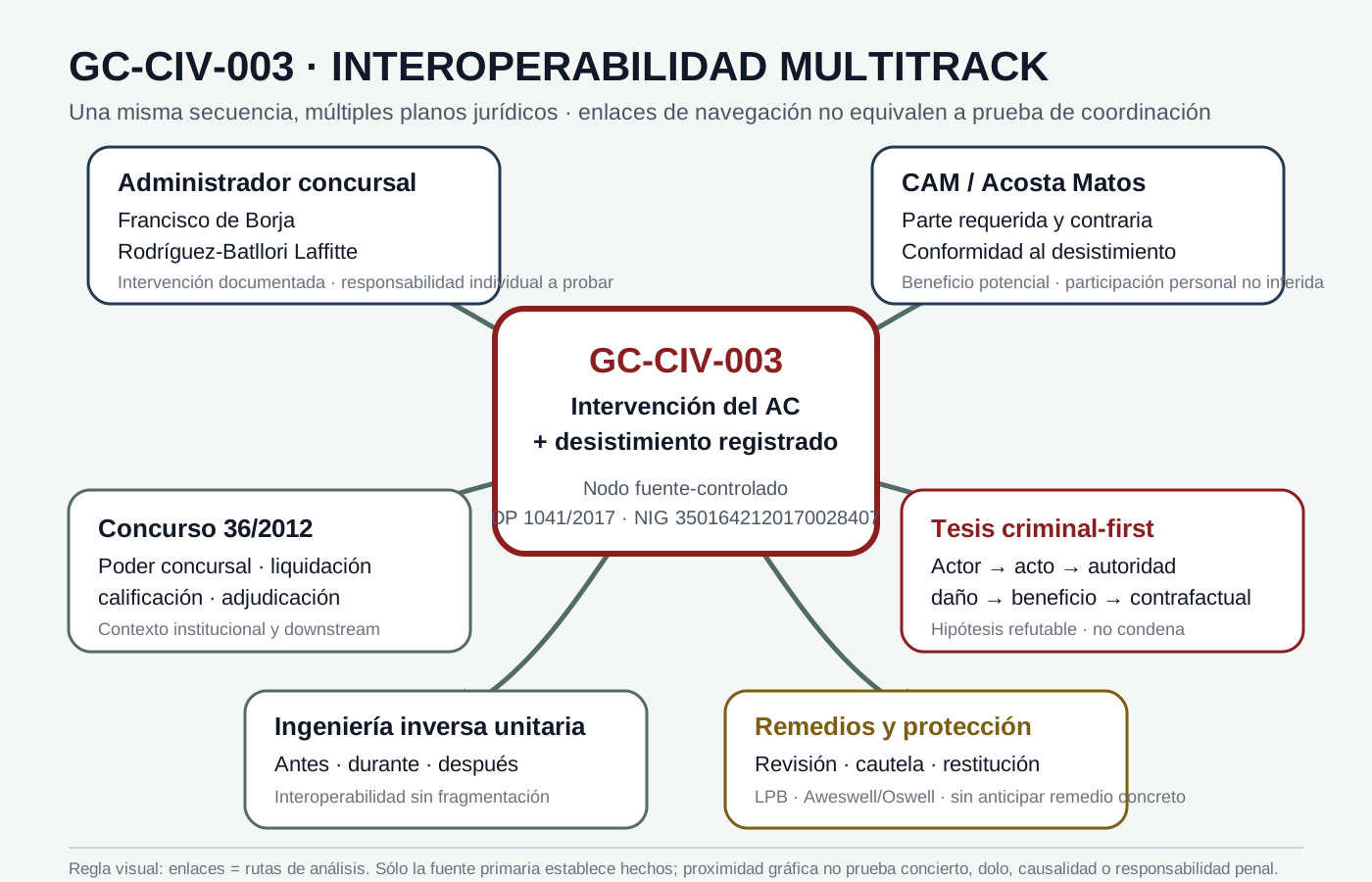
GC-CIV-003 multitrack map connecting the insolvency administrator, CAM and Acosta Matos, Concurso 36/2012, the criminal-first thesis, unitary reverse engineering and the remedies question.
Multitrack interoperability map. GC-CIV-003 is treated as a source-controlled node. The routes allow navigation across actor, proceeding, potential benefit, downstream consequences and remedies while preserving the rule that navigational proximity is not proof of coordination or intent.

Perimeter interconnection

OPEN PROFESSIONAL INVITATION

A remedies question, not merely a labels question.

Gil Marer invites criminal lawyers, public-law specialists, insolvency lawyers, civil lawyers, academics and other professionals with relevant experience to examine this episode from every legally available angle, with priority given to the criminal hypothesis but without excluding the others.

Of particular interest is the intersection between possible actor-specific criminal responsibility, unjust or unjustified enrichment, protection of the estate and its economic stakeholders, invalidity or review of acts where legally available, interim and protective measures, restitution, compensation, and the consequences that may follow where a public or private decision rests on conduct that is ultimately established to have been unlawful.

The question is not framed here as a conclusion that any particular remedy is already available. It is framed more usefully: if the evidential sequence is confirmed, what mechanisms can protect, correct or restore the position that properly belonged to LPB and the AWESWELL LIMITED perimeter, and what downstream legal effects should then be reviewed?

Those able to contribute doctrine, case law, comparators, procedural experience, criminal or administrative-law analysis, primary documents or a verifiable alternative explanation are invited to contact Por Derecho about GC-CIV-003 specifically and the connected files more generally.
Open limits

  • The actual outcome of the 19-Feb-2018 listing and any equivalent document production.
  • The original discontinuance filing: text, material author, filer and procedural authority relied on.
  • The full CAM filing dated 25-Feb-2018, registry 1222/18.
  • The specific legal basis relied on by the AC to end/change the professional relationship and control further filings.
  • Service and ultimate finality of Decree 000139/2018.
  • Any communication linking an individual Acosta Matos person to the decision to discontinue.

Closure rule: primary material that contradicts the hypothesis must be incorporated with equal traceability. Silence is not treated as an admission.

← Back to GC-CIV-003