INSTITUTIONAL FIRST READ

Test the finite record before evaluating the wider allegation.

Use the same controlled evidence base to inspect source status, contrary material, procedural scope and open gaps.

Boundary. Navigation does not establish joinder, receipt, admissibility, knowledge, reliance, wrongdoing or merits.

INSTITUTIONAL UPDATE · 20–21 AUGUST 2026 · SOURCE CONTROL

Two separate tracks: Public Prosecution for criminal/economic investigation; CGPJ for record integrity, transmission and functional classification.

The record is now narrower and more precise. The CGPJ Appeals Section has confirmed joinder of the identified submissions to Appeal 286/2026, while central prosecutorial acknowledgements establish receipt only. Neither development decides the merits.

Appeals: five-file package + two later annexes + audiovisual link incorporated · Appeal “en trámite”

Precision rule. The Appeals Section confirmation proves receipt and joinder of the identified material and the current procedural description “en trámite.” It does not prove acceptance of any allegation, examination of every proposition, referral to Inspection, a favourable outcome or any merits finding. The separate Fiscalía acknowledgements prove receipt and anticipated management only.
Controlling correction · 21 August. The documentation sent on 28 July, entered in the electronic registry on 29 July with five attachments, was received and joined to Appeal 286/2026. The two newer graphic files and the audiovisual-source link were also incorporated on 21 August. The General Secretariat message remains sent with receipt/association unproved; the separate general Information attempt failed delivery.

SUPERVENING EVENT · 18 SEPTEMBER 2026

DP 1901 now contains a prosecution act identified by date and a later judicial disposition.

Relevance to Alzada 286/2026. The 28/29 July package had already requested the DP 1901 prosecution report and later order. The 14 September order now records a 29 July Public Prosecution report seeking dismissal and orders final dismissal/archive. The signed report, author, source corpus and assignment remain open; the daily-reference 21 private filing and daily reference no. 24 judicial filing also require reconciliation without assuming the direction of any error.

This event can be prepared as a supervening submission in Alzada 286/2026 if separately authorised. No CGPJ submission is made by this repository update. The CGPJ issue remains functional classification, traceability and institutional functioning; it does not replace the criminal remedy or decide guilt.

Corpus ready for testing. DIP 2/2026 now has all six located core documents digitised — 13 January complaint, 8 February amplification, 6 March Decree, 9 March notice, 11 March update and REGAGE receipt — and the 14 September DP 1901 order is fully transcribed from its three source photographs. The separate 11 February opening decree, complete certified file, 29 July prosecution report and transmission trace remain missing.

Open the DP 1901 update → · Open the digitised DIP 2/2026 room → · Discrepancy ledger →

CGPJ · DI 169/2026 · Appeal 286/2026

One confirmed appeal record, one unconfirmed routing message and one failed address.

Received, joined and in progress.

The Appeals Section confirmed that the five-attachment filing entered on 29 July was joined to Appeal 286/2026. It also incorporated the two later graphic annexes and the audiovisual link on 21 August. The current status was expressly stated as “en trámite.”

Association and functional routing remain unproved.

A message was sent asking that any court/service-functioning issue be routed to the competent function, without turning it into review of judicial merits. No delivery-failure notice was located, but receipt, association and any functional routing have not been confirmed.

Delivery failed.

A final delivery-status notice states that the general Information address was not found or unable to receive mail. This attempt cannot be treated as a valid routing checkpoint. The failure does not prove deliberate blocking or the absence of another valid institutional route.

A · Integrity — confirmed

The identified 28/29 July five-file package, the two later annexes and the audiovisual link are now confirmed as incorporated into Appeal 286/2026.

B · CGPJ → TSJ — open

The outgoing CGPJ record still needs reconciliation with the TSJ statement that receipt of the DI 169/2026 communication was not recorded there as of 20 August: dispatch, channel, addressee, identifier, transmitted documents and delivery status.

C · Classification — open

The final decision may still need to distinguish judicial merits, judicial discipline, court functioning/Inspection, LAJ/court-office matters and matters outside CGPJ competence.

Joinder-status rule. Joined to the appeal means available within that appeal record; it does not mean that every attached proposition has been accepted, independently verified or adopted.
Transmission boundary. The TSJ's non-recorded receipt does not prove that the CGPJ failed to send the agreement or that loss or irregularity occurred. The remaining objective is to reconcile the outgoing and incoming records.

PUBLIC PROSECUTION · DIFFERENTIATED ROUTING

Central receipt is confirmed; assignment, admission and merits remain open.

The professional/economic layer was routed separately through territorial, provincial, higher, central and specialised prosecutorial functions, while keeping private/extrainsolvency, judicial/privileged-forum, economic-tax and professional/information modules distinct.

Four central acknowledgements · 21 August. The Secretaría Técnica separately acknowledged the communications directed to the Fiscal General del Estado, Inspección Fiscal, ST 553/2026 / ST 104/2025 and the Economic Crimes coordination route, stating that each would receive the corresponding management as soon as possible. These messages establish receipt only; they do not establish association with a specific file, assignment to a named unit, admission, opening of proceedings or a merits view.

National Court Prosecution · Exp. Gub. 86/2026

The later communication separated three tracks: the criminal referral to Arrecife; the separate Pink/AEAT tax-contentious proceeding; and other institutional antecedents. It also distinguished material already contained in the 2 August package from genuinely subsequent professional sources.

Control: the Pink/AEAT litigation proves a real tax-law route, not by itself the criminal hypothesis concerning private provenance, transmission or exploitation of information.

Anti-Corruption Prosecution

The Special Prosecutor's Office acknowledged receipt and stated that the communication was pending admission, identifying the signature/e-identification requirement for giving course to a written or telematic complaint.

Control: acknowledgement ≠ admission ≠ investigation ≠ merits decision. The immediate procedural step is a signature cure that preserves the existing scope.

Consequence for the CGPJ. These prosecutorial tracks reduce, rather than increase, the need to send the CGPJ a broad criminal/economic theory. The CGPJ retains judicial-governance questions; prosecutors retain investigation and external-source acquisition issues.
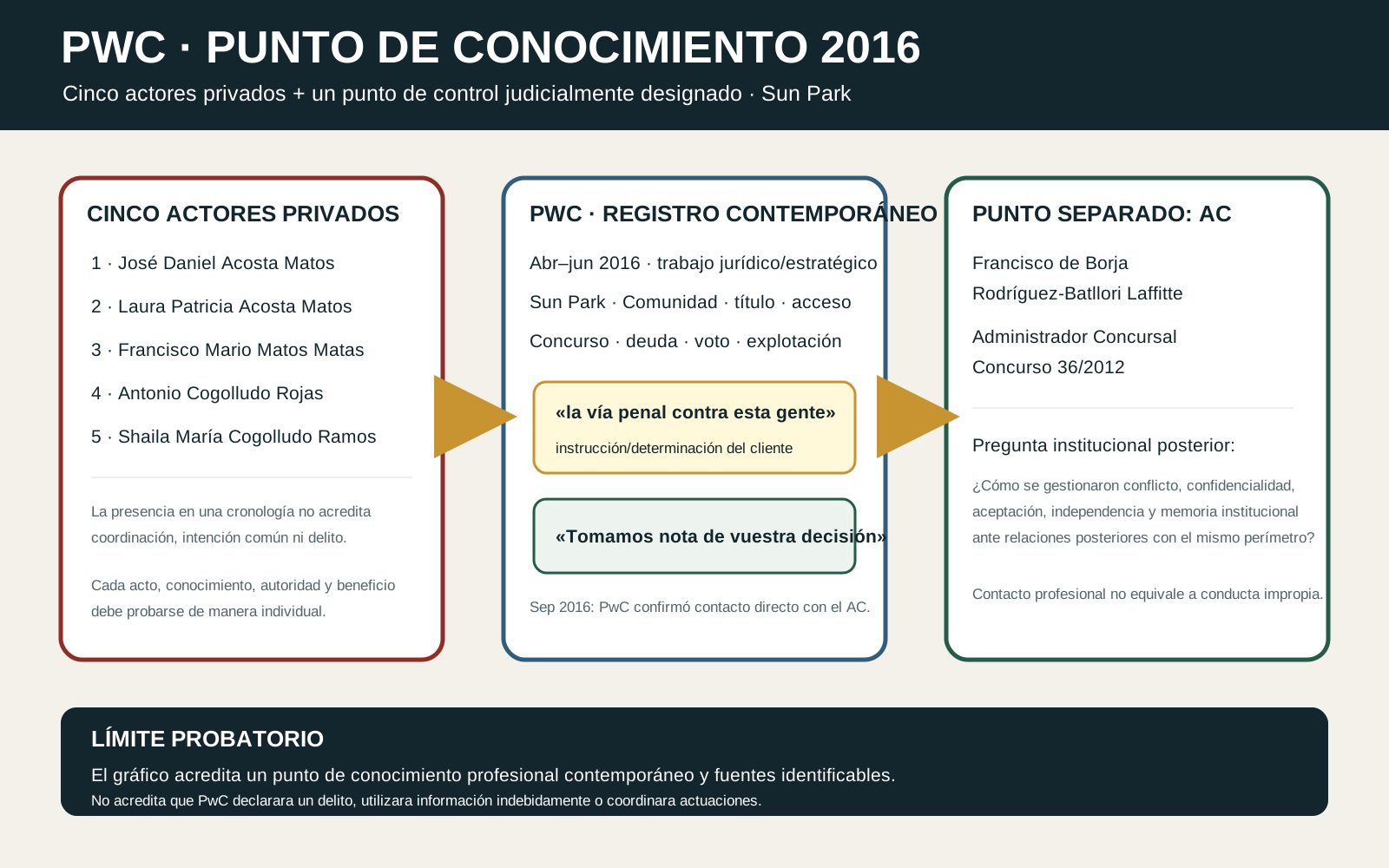
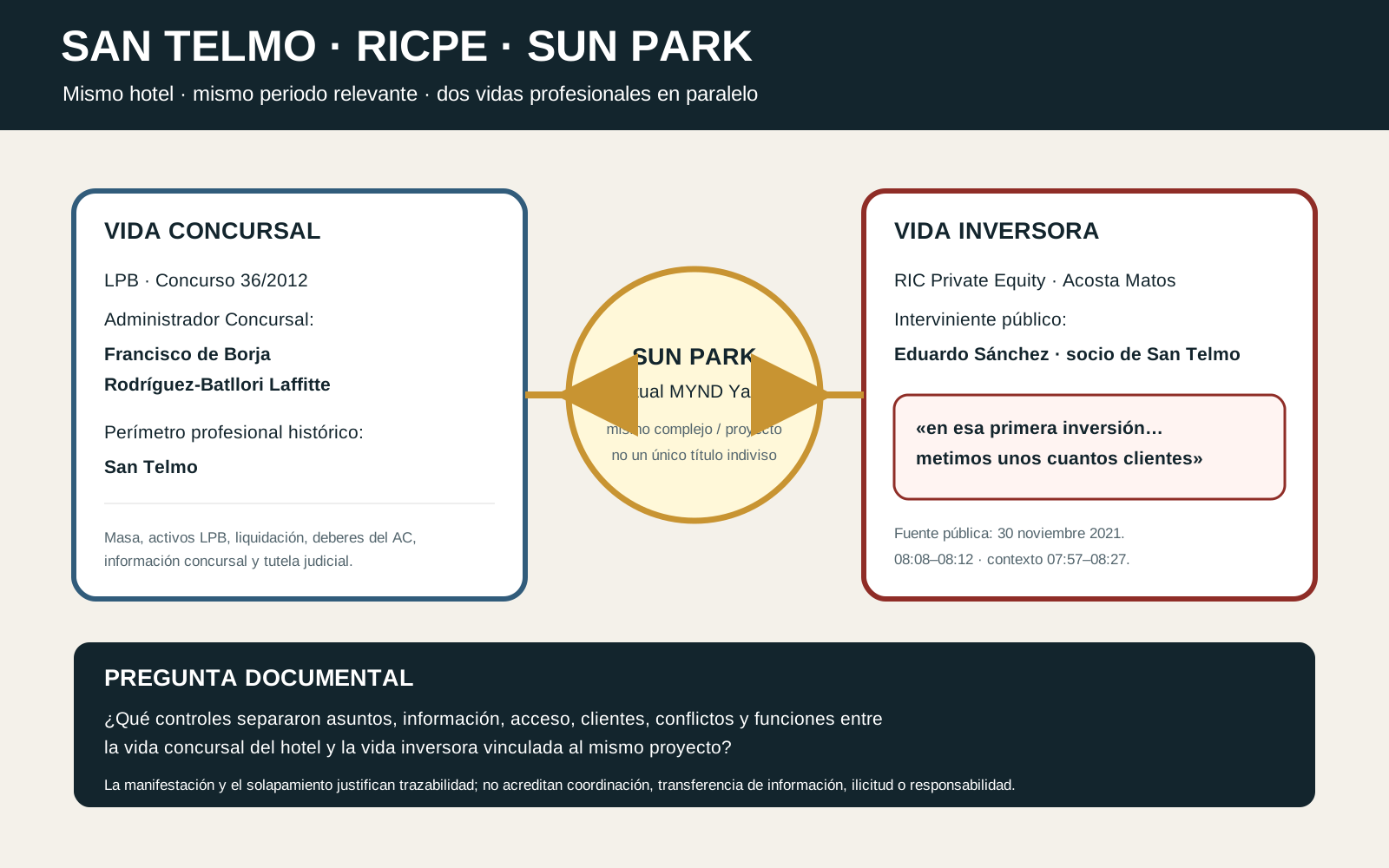
SOURCE PACKAGE

Two visual source indexes and one audiovisual source, with express limits.

PwC, five private actors and Insolvency Administrator: 2016 professional knowledge checkpoint
PwC · 2016. Knowledge and the client's instruction identify files and custodians. They are not equivalent to a PwC finding that a crime occurred.
San Telmo, RICPE and Sun Park: insolvency life and investor life
San Telmo / RICPE. The source identifies potential client-introduction and information-separation records. It does not prove coordination with the insolvency administrator or illegality.
Direct audiovisual source
Relevant passage approx. 08:08–08:12 · control context 07:57–08:27.
Open at 08:08

CRITICAL OPEN CONTROLS

Only the remaining finite steps.

CGPJ

Reconcile the CGPJ outgoing transmission with the TSJ receiving record; await any General Secretariat functional-routing response; preserve the final Appeal 286/2026 decision. Do not resend the material already confirmed as joined.

Public Prosecution

Cure the Anti-Corruption signature/formalisation defect; obtain the Arrecife receiving reference when a finite status request becomes due; await the FGE management/routing outcome rather than sending another same-day central duplicate.

Professional and supervisory records

Allow the PwC, Grant Thornton and RSM response windows to run. Read and preserve the additional RICPE ethics-channel information before characterising the channel response or making another broad escalation.

Correction and contradiction. If an institution, firm or affected person supplies a primary record correcting, completing or contradicting this sequence, the record should be updated. Native sources and official files control over this public synthesis.